Auden cares for Thisbe through the night
Along for the RideAuden’s sunrise care for Thisbe marks a shift from watching the household’s strain to taking responsibility within it. After a night of guilt and tears, Auden leaves her room, offers Heidi rest, and pushes the relentlessly crying baby along the deserted boardwalk. The walk is both a practical discovery—motion briefly quiets Thisbe—and a turning point in Auden’s relation to her family: she responds to Heidi’s exhaustion with sustained, unasked-for care, even as her own understanding of what the night means remains unsettled.
The Night and the Offer of Help
The walk follows a difficult evening for Auden. After a hurried encounter with Jake behind the dunes, she returns home feeling that her behavior has been strange and unlike herself. She tries to turn back to her economics textbook, but the night’s events crowd the page; tears blur the words. Then Thisbe begins crying again, and Auden hears Heidi come down the hall and enter the baby’s room. The distress reaches Auden first as sound, before she has made a decision about what to do.
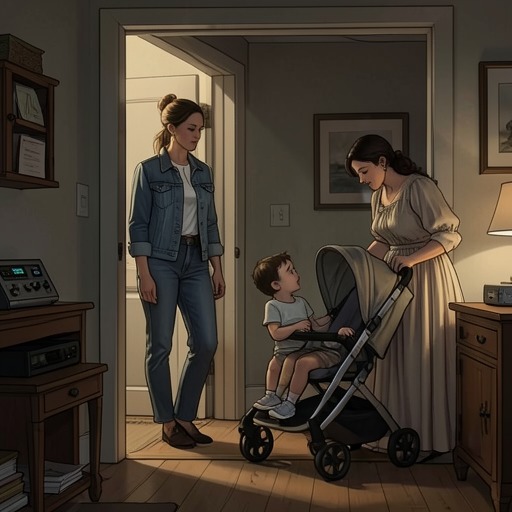
Thisbe continues crying for an hour, long after Auden’s own tears have dried. Auden recognizes that guilt may be part of what draws her out, but also that she needs a distraction from her own problems. She opens the nursery door without knocking. Heidi is in the rocking chair, her face ragged and tear-streaked. Auden holds out her arms and tells her, “Give her to me,” adding, “You get some rest.” The offer is direct, but Heidi hesitates despite her obvious exhaustion. Auden steps closer and urges her on; only then does Heidi exhale and let Thisbe pass into her sister’s arms.
The handover does not instantly solve anything. Heidi says that she does not know what Thisbe needs and cannot listen to her cry anymore. Auden tells her to go, sharply enough that Heidi gets up and leaves for her room. The baby remains in full voice, and Auden is now alone with the care she has volunteered to take on. The scene’s significance lies in this concrete transfer of responsibility: Heidi is allowed to withdraw from the crying for a while, while Auden stays present with a need she cannot yet explain or quiet.
Motion on the Walk
At first Auden tries to settle Thisbe by carrying her around the house: through the baby’s room, downstairs, around the kitchen island, and back into the living room. Walking quiets her a little, but not much. Then Auden notices the stroller by the door. At about five in the morning, she straps Thisbe in and pushes her down the driveway, with the baby still hollering. By the mailbox, only about twenty feet away, Thisbe stops.
The silence proves temporary. Auden pauses to look down, and Thisbe draws breath and starts crying louder than before. Auden pushes again; after a few turns of the wheels, the crying stops. She picks up the pace and turns onto the street. This small experiment gives the scene its practical rhythm: quiet, renewed crying, movement, and quiet again. Auden does not claim to know what Thisbe needs; she watches what happens and keeps moving when the baby begins again.
By the time they reach the business district, Thisbe is asleep beneath her blanket, her face relaxed. Auden pushes her along the deserted boardwalk, with a brisk breeze crossing it and only the ocean and the stroller wheels audible. They walk as far as the Last Chance Café before another person appears in the distance. The route carries them back toward Clementine’s, whose orange awning Auden recognizes as she approaches. What began as a test of whether the stroller might help has become a long passage through the waking town, made possible by Auden’s persistence and Thisbe’s response to motion.
The Cyclist and the Shared Night
Near Clementine’s, Auden sees a cyclist performing a fluid series of maneuvers where the boardwalk opens onto the beach: lifting onto the front wheel, hopping forward, turning the handlebars, pedaling backward, zigzagging, and banking off a bench. The movements hold her attention because they recall the rocking chair and the stroller: in each case, motion seems to have a calming power. The cyclist is the same dark-haired young man in a blue hoodie Auden had encountered earlier on the path, but this time her stroller and its occupant catch him by surprise. He skids to a stop, and the two look at each other without greeting.
Thisbe begins crying again, briefly making their silent encounter awkward. Auden pushes the stroller forward and back, and the baby quiets at once, still awake and looking up at the sky. Auden explains that it has been a long night. The young man looks serious and answers, “Aren’t they all.” Before Auden can reply, he pedals away, zigzagging down the boardwalk rather than taking a straight line. His departure leaves the encounter unresolved, but it places Auden’s private vigil beside another figure’s solitary activity in the early morning. The scene offers no explanation for his remark; its force comes from the brief recognition that exhaustion need not belong to one household alone.
Care Beyond the First Walk
The walk does not stand alone in Auden’s experience of caring for Thisbe. Later, she comes upon Heidi sitting in the dark living room with the baby in her arms, silently weeping. Auden moves closer and asks to take Thisbe, but Heidi shakes her head. When Auden seeks help, Mrs. Stock arrives and directs Eli to take the baby upstairs and swaddle her, telling Auden to trust that she will manage Heidi. The moment echoes the first night’s handover while showing that Auden is not the only person who can respond to a crisis: care can mean taking the baby, or arranging the support that another person needs.
Heidi later tells Auden that she has realized she needs time for herself and has talked about it with Karen. The change appears in ordinary social life as well: one evening, Auden finds Heidi with Maggie, Leah, and Esther around the kitchen table, bags piled up and music playing, and Heidi invites her to join them. Still later, when Isby cries in her stroller, Auden assumes she should stay and tend to her. Auden’s mother insists on taking the baby herself, reminding her that she raised two children and can be trusted for an hour. Across these episodes, Auden’s first dawn walk becomes one part of a broader, shifting distribution of care. She learns to act when someone needs her, but the later scenes also make room for her to accept help and leave the baby with others.